Ever wonder how we make the yeast beads for our immobilized cell bioreactors? We wish we could say it’s simple, but we’d be lying…
- It all starts with dry alginate powder
- the alginate gets dispersed into sterile hot water. Both “sterile” and “hot” are key here. The air bubbles are removed from the mixture and the alginate is chilled overnight.
- we then mix in (lots of!) yeast and stir it up really well to make a homogeneous mixture. This part looks really cool as the clear alginate swirls with the beige yeast.
- the yeast + alginate mixture is loaded into a sterile pressure tank and then extruded out of the emitter head that Zac made in the shop.
- The droplets fall one by one from the emitter (at about 100 per second) and fall into a sterile bath of 3.5% calcium chloride. This turns the liquid mixture into a gelatinous ball. This happens because the calcium replaces the sodium ion in the alginate making the alginate fibers go from smooth to something resembling velcro.
- The gelled bead is washed in a couple of baths with a final soak in a sucrose solution to wash out any calcium chloride and to “wake up” the dormant yeast cells.
- The final yeast beads are (literally) ladled into the waiting, freshly sterilized bioreactor. In this gelled state, the beads are very porous and are actually more like a mesh sphere than a solid rubber ball. This lets sugar flow into the bead, alcohol and carbon dioxide to flow out, but the yeast are stuck inside (It’s cool, they love it in there)
- The new bioreactor is loaded into our reactor room and hooked up to the system. These beads will last about 2 months before the whole process starts again.
Where’s your pot still?
Yep, we don’t own a pot still. Sure, we have a still and it has a “pot” boiler, but that’s where the similarities begin to decline. When we started Industry City Distillery, the goal from day one was to create vodka, so we commissioned equipment to do just that.
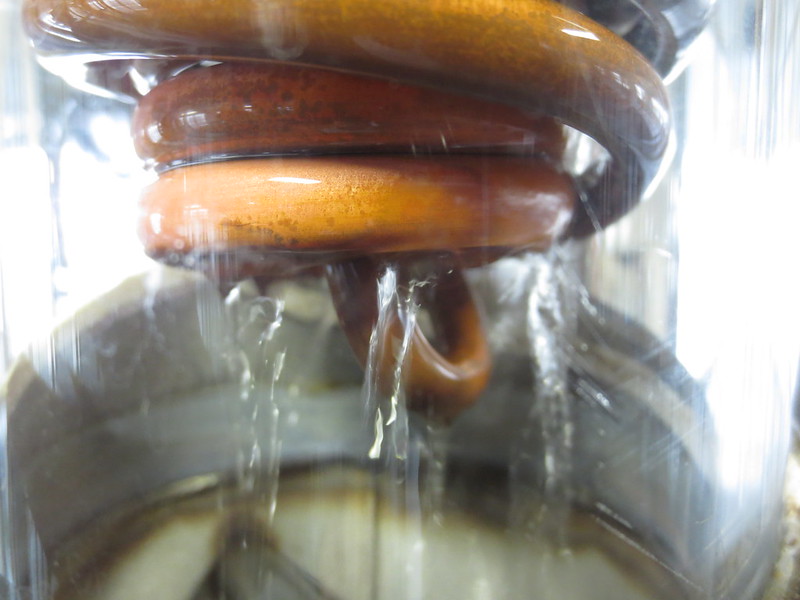
95.6% alcohol coming off our main condenser
Vodka has a few legal requirements that make it “vodka”, but the most important one is the proof that it’s distilled to, and you just can’t do it efficiently with a pot still. Here we’ll look at how pot stills work, why they’re a bad match for vodka, and what other options are out there.
Chris Parker made this video for the distillery back when we were still producing our 375ml test batches. Still just as true as it’s ever been.